

Ancient Vietnamese tea trees do not grow in neat rows on hills. They grow scattered in the forest, their trunks taller than a person, their bases covered with moss and lichen, interspersed with other forest trees. To pick them, one must climb, and to climb, one needs a local guide.
That's why the story of the tea region is always intertwined with the story of its people: the Hmong, Dao, and Hà Nhì families who have lived alongside the tea forests for generations.
Y Tý, Bát Xát — Lào Cai
Located at an altitude of over 2,000 meters, Y Tý is almost year-round shrouded in clouds. The large day-night temperature swings cause the tea trees to grow slowly, accumulating many compounds, and their buds are covered with a thick layer of white down.
This is the source of ingredients for Việt An Trà's white tea batches, including Y Tý White Peony. The main harvest season falls between March and April, when days are warm but nights are still cold.
The path to the village during the rainy season is often muddy; often, tea has to be carried long distances on foot before it can be loaded onto a vehicle.
Tây Côn Lĩnh — Hà Giang
The Tây Côn Lĩnh mountain range is one of the oldest surviving Shan Tuyet tea regions. Some tea trees have trunks so wide they require two people to embrace them, their age calculated by locals in terms of "grandfathers' generations."
The tea here is rich and robust, with a long-lasting sweet aftertaste, very suitable for making aged raw pu-erh pressed into cakes.
The Red Dao people in the region have a custom of not cutting down tea trees, even when clearing land for farming. This custom has preserved the tea forests to this day.
Suối Giàng — Yên Bái
At an altitude of about 1,400 meters, Suối Giàng is famous for its ancient Shan Tuyet tea population. Thick fog and deep humus soil contribute to plump buds and distinct floral aromas.
This is the source region for green teas and black teas with a light, easy-to-drink flavor, suitable for beginners.
How Việt An Trà Works with Tea Regions
We purchase in batches, not mass-collected. Each batch is associated with a specific tea area, a harvest season, and a particular tea maker.
The purchase price is negotiated directly with the picking and processing households, without intermediaries. Payment is made in full during the season, as it is the main income for many families throughout the year.
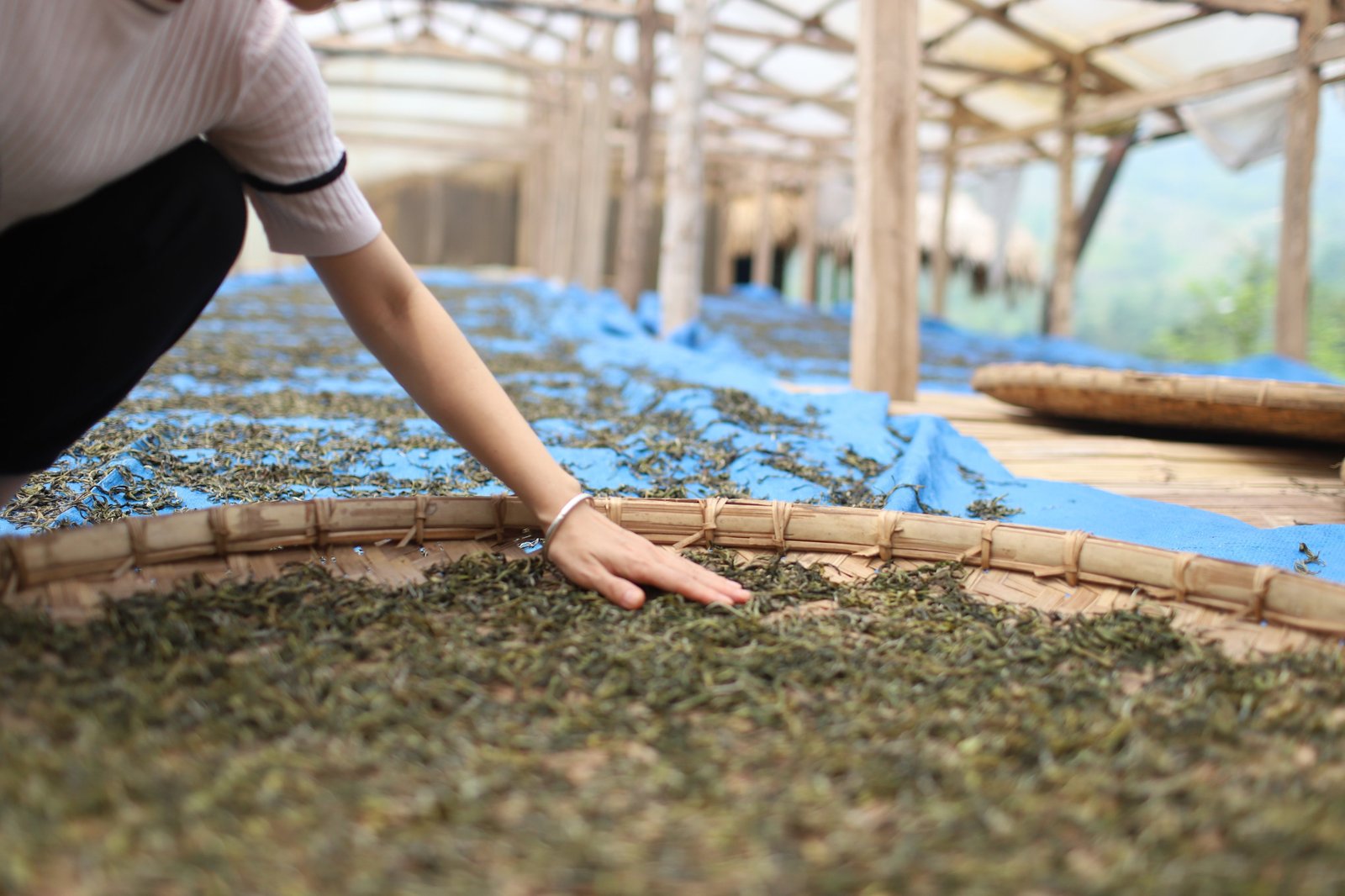
The processing workshop is located directly within the region, so tea buds do not have to travel far before being withered.
The yield of each batch is therefore very small and non-replicable. Once a batch is gone, it's gone; the next season will bring a different flavor, and we clearly state that on each box.
Preserving the Tea Forest is Also Preserving the Craft
Ancient tea trees cannot be replanted within a lifetime. A cut trunk is lost forever.
For us, buying tea at a fair price and consistently every year is the most practical way for a family to see the tea forest as more valuable to preserve than a cornfield.
If you've ever drunk a cup of tea that leaves a sweet sensation at the back of your throat after swallowing, that sweetness originates from an ancient tea tree still standing in the forest.